1 2 3 4 5 6 7 8 9 10 11 12 13

Core CLR and System.Xml

09 Jun, 2015

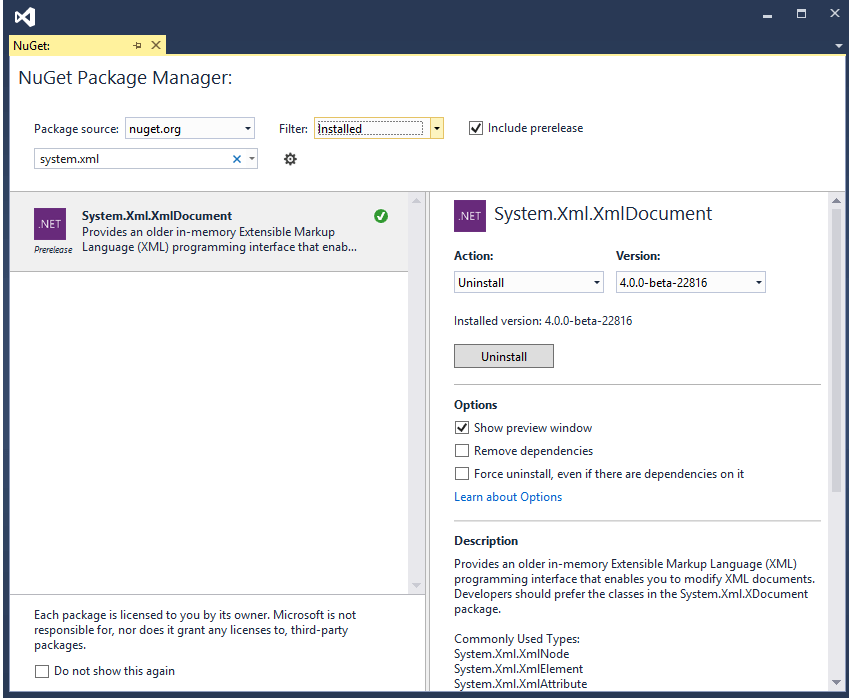
If you need to use some package which is dependent on System.Xml with Core CLR / DNX Core you simply add the Nuget package System.Xml.XmlDocument rather than referencing the GAC System.Xml.

This allows you to keep your code in Core CLR friendly mode.

System.Xml.XmlDocument on NuGet

...

Visual Studio 2015 and Gulp

03 Jun, 2015

Having played around with the Visual Studio 2015 preview a bit I've tried to learn how Gulp integrates with the Web Application project.

Gulp seems like one of those many, many, constantly appearing JavaScript libraries with names like YamahaPotplantSaucepan.js which are impossible to keep up with. However since it takes the place of the Bundle config it's important to be able to achieve a basic level of familiarity with it.

What does it do?

Gulp describes itself as a "streaming build system" which basically means you can wire up a pipeline of operations to perform on your content, such as JavaScript and CSS.

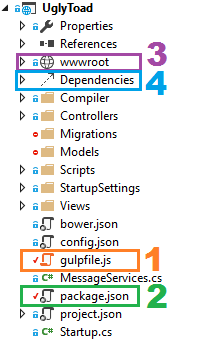
By default the project template comes with a gulpfile (shown in the image as #1). This is configured to take the dependencies from Bower (which is a package manager loading a few jQuery packages in by default) and copy them to the wwwroot/lib folder (#3 in the image).

1 is gulpfile.js, 2 is package.json, 3 is wwwroot folder, 4 is dependencies folder

...

SpecFlow looking for When instead of Given step

20 May, 2015

When writing some automation tests using Selenium with SpecFlow recently I was faced with an odd error:

    No matching step definition found for the step. Use the following code to create one:
    [When(@"I add a new dog")]
    public void WhenIAddANewDog()
    {
        ScenarioContext.Current.Pending();
    }

The suggested code was using a [When("My Scenario")] step despite the feature file declaring it as a Given:

Scenario: Check for existing dog
    Given I have a new Dog Controller
    And I add a new dog
    When I check if the added dog exists
    Then The check is true

(This feature is written badly to illustrate the error).

The step it couldn't find was the And I add a new dog step. Despite showing as bound in the feature file and being able to navigate to the step definition, the running test couldn't find it and was looking for a When instead of a Given.

This is because the previous step was calling sub steps as follows:

public class DogControllerSteps : Steps
{
    [Given("I have a new Dog Controller")]
    public void CreateDogController()
    {
        Given("I have a new query bus");

        When("I create a new dog controller");
    }
}

Inheriting from Steps allows us to reuse step definitions from the same or other step files.

When SpecFlow runs this it knows that it last ran a When step, despite being in the definition of a Given. Therefore when the next step is defined with And, it looks for a When. To fix this you can simply change your feature to be more specific:

Scenario: Check for existing dog
    Given I have a new Dog Controller
    Given I add a new dog
    When I check if the added dog exists
    Then The check is true

Passing tests :)
...

3-tier CQRS using Web API as a command/query bus

16 May, 2015

We recently started using CQRS on a project to provide a new web application to manage a complicated permit process. The CQRS pattern combined with a proper domain model seemed like a good fit for the business logic.

Midway through development of our 2 tier solution (Web <-> Database) we were asked to instead asked to develop a 3 tier solution (Web <-> Api <-> Database) to avoid exposing the database to the web server (no WCF allowed).

Initially the change slowed development and resulted in an explosion in the Lines of Code to functionality ratio. After some thinking we realised it might be possible to use Web API as a command/query bus for our pre-existing CQRS setup, effectively allowing us to "pass-through" the API without needing to write a controller action per command.

This post summarises the ideas behind the working approach we developed. All the code used in this post can be found on Github but the code is very obviously simplified; both to avoid revealing implementation specific details such as security and to allow this post to focus on the concepts.

CQRS

If you're not familiar with CQRS read some of the articles available on the advantages and disadvantages of the pattern. Basically you separate commands (actions which update data) from queries (which read data).

This post will only deal with implementing the query side of CQRS over Web API. Commands should be simpler.

Query and QueryHandler interfaces are defined in a separate CQRS class library (ideally Queries and Query handlers live in separate libraries because your web project shouldn't have to reference query handlers).

...

Fun with Nuget

14 Apr, 2015

I recently finished the first release of my 2nd Nuget package which provides a class to convert an ADO.Net DataTable to a list of objects. This is the result of an effort to create a library for the conversion technique outlined in this post.

I've also created a Nuget package to help out with MVC 5 Radio Buttons located here.

This post summarises some things I learned from creating these Nuget packages.

Simplest package

For simply packing a class library targeting a single version of the .Net framework you can simply invoke the Nuget.exe with the path to the .csproj:

.\.nuget\NuGet.exe pack .\Path\To\Project.csproj -Prop Configuration=Release

If your solution doesn't have a copy of the Nuget exe in the .nuget solution folder you can download the exe separately.

This command will create the nuget package in the current directory with the metadata declared in the AssemblyInfo.cs for the project.

Creating a specification

The default nuspec specification file created by calling:

...
1 2 3 4 5 6 7 8 9 10 11 12 13