Cheese sandwich
If you are the type of person with Very Strong Opinions about the (negative) health and moral implications of plant-based 'meat' you are signalling that you are fundamentally intellectually incurious. You have an opinion you haven't taken the time to inspect and have adopted certainty without rigor.
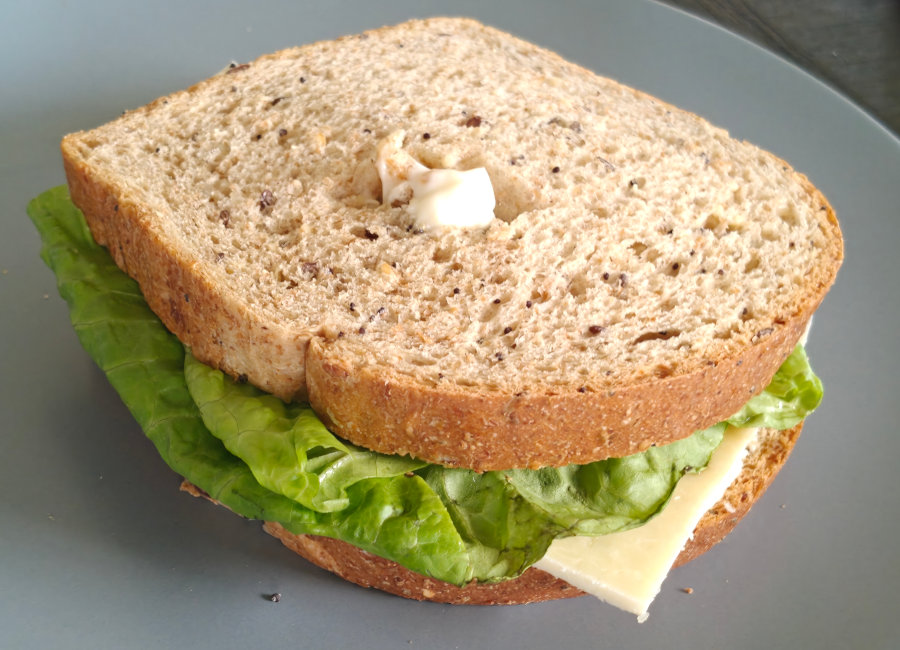
This is a picture of a cheese sandwich, I made it at home, it was ok:
And this is the ingredients list of that cheese sandwich:
- Lettuce
- it's a lettuce
- Tomato
- it's a tomato
- Balsamic vinegar (a small drizzle rescues supermarket tomatoes from their cardboard nature)
- wine vinegar
- concentrated grape must
- cooked grape must
- coloring E150(d)
- Mayonnaise
- rapeseed oil
- egg
- spirit vinegar
- pasteurised egg yolk
- lemon juice from concentrate
- sugar
- salt
- mustard extract
- paprika extract
- Cheddar cheese
- pasteurised full fat milk
- vegetarian rennet
- salt
- starter culture
- Bread
- wheat
- rye
- barley
- oats
- millet
- corn
- sesame seeds
- sunflower seeds
- linseed
- soy
- 100% vegetable shortening
- sugar
- molasses
- salt
- yeast
- calcium propionate
- Pickle
- carrot
- rutabaga
- onion
- cauliflower
- sugar
- barley malt vinegar
- spirit vinegar
- salt
- tomato puree
- dates
- rice flour
- apple pulp
- modified maize starch
- sulphite ammonia caramel (color)
- onion powder
- lemon juice
- spices
- colouring food (barley malt extract)
- herb and spice extracts
- Add ham to taste.
Now, is this sandwich the healthiest food in the world? No, not really. But I hope you'd agree it's not complete poison either. Most of the ingredients list are recognizable things. Except rutabaga, I have no idea what rutabaga is, but Wikipedia tells me it is turnip. Importantly, many of them are things that have been through multiple processing steps. That's just what we do with food, we make ingredients into other things. We've been doing this for millennia.
What is spirit vinegar? Per "The Vinegar Institute" (which sounds fun) all vinegars start out as agricultural sugars that are first fermented into alcohols, followed by the alcohol being fermented into acetic acid by other bacteria. What about modified maize starch? Modified how? Sounds pretty suspect. Well, the website "Starch in Food" (I'd bet a 'The Vinegar Institute' and 'Starch in Food' get-together is a real party) says it is a starch extracted from some kind of grain or vegetable treated to improve its uses in food in one of three possible ways:
- Cooking/roasting
- Enzymes
- Chemicals
The packaging doesn't specify which of these 3 methods was used and it doesn't really matter. I'm fine eating this stuff. A cheese sandwich is full of chemicals. I'm full of chemicals, you are full of chemicals. Toilet bleach is chemicals, so is a lettuce. Food containing chemicals tells you nothing more than whether or not the food is a vacuum. Which brings me onto the topic of my rant.
If you have strong opinions that plant-based meat substitutes are unnatural or unhealthy solely on the basis of their ingredients list you are being incurious and I'm sick of hearing about it. These days you can't move for people who have Opinions that they can't wait to tell you if you order one of these things. And I don't think these people have come to their Capital-O Opinions organically; and I don't think they've inspected why they think what they think. And that's intellectually lazy.
In general there are different reasons someone might choose to adopt a vegan diet, vegetarian diet or simply choose to eat less meat. Each person will have their own reasons.
- Health reasons.
- Moral reasons, a piggy is much like a cute little doggy but we only raise one of the two in horrendous conditions before murdering it and chopping it into pieces. (The dairy and egg industry are, if anything, crueler, but in life you generally have to decide at what point you're making the perfect the enemy of the good, and that decision is up to you)
- Environmental reasons, the environmental footprint of meat (and dairy) is generally larger than vegetarian foods.
- Taste, some people don't like the taste of meat.
Strong Opinions on plant-based meats are usually one of either:
- These taste bad and aren't really like meat. Which, sure, y'know, I think olives taste bad, but I'm not annoyed by the olive section of the supermarket. Just don't eat them.
- These are frankenfoods. They are fundamentally unnatural. They are extremely unhealthy, made in a lab, and you, as someone who eats them, have sinned. These foods will kill you and my real meat burger or sausage makes me not only a moral paragon, but someone who will outlive you because I have the true science.
- There is a 3rd, weaker, claim, often from other vegans or vegetarians. This is that you shouldn't need them and as a vegetarian you should be happy with only chickpeas, lentils, black beans or tofu for every single meal for the rest of your life. This usually ties into the health concerns around them. If you don't like them and you're happy with pulses forever that's great for you. But try to be a bit less prescriptivist about this please.
The health claim is the main one, and the one that has done the greatest damage to both the industry and the consumer demand for these products. We've already seen how a fairly mundane sandwich starts to sound like it was produced in an RV in New Mexico if you start to deep dive into how we process and transform ingredients.
But my response would be two-fold. If we concede the point, let's assume these ingredients are unhealthy, well... so what? It's irrelevant. I'm not eating a burger, hot-dogs, chicken nuggets or sausages to be healthy, whether meat-based or plant-based. I'm having them slathered in sauces and cheese, with fries and onion rings. Because that's nice food, not for every day, but it's a cultural mainstay of my food culture. Some days you can have pasta and sauce, some days, too many days, you can have various lentil stews or curries, but some days you just want a damned burger. Some days you just want some junk food. But these options give you junk food without the bit where an animal spends its short life in abject misery before being slaughtered in terror.
But I'm not conceding the point because I don't think you have standing to make it. I have very little confidence in strong claims made about dietary science by lay-people.
It used to be that fat was the enemy, and then it was hydrogenated versus non-hydrogenated fats. Eggs were going to kill you but now they're maybe ok. But actually probably sugar will kill you. Now maybe seed oils will, or won't, or will only do it if you heat them beyond their smoke point. Maybe sweeteners protect you from the ill-effects of sugar or maybe they kill you in an even worse way. Are nitrites in your bacon going to kill you, is red meat? Are plant-based meats? Does a glass of red wine help my heart? Does dark chocolate? Is frying everything in beef tallow the answer? How are you going to live forever?
Dietary science seems to me to be the weakest field of science, how do you pull out effects from the noise of everything people eat and interact with in their entire life? How do you get good enough source data from self-reported food diaries? How do you run big enough studies? This isn't an anti-science rant, we just need to do better science.
But pop-science beliefs from dietary science always follow the same pattern. Some pre-print or university press release, or crank self-published article, gets picked up by the media and through word-of-mouth, or funded amplification by lobbyists, becomes the villain of the moment. It's easy to understand why this happens, sickness is scary, mortality is scary. The idea that there's some key to avoid it, some guidance that can become a moral framework is extremely alluring. Just take a shot of apple cider vinegar each day, just avoid sugar, just avoid sucralose, just avoid anything with chemicals, avoid margarine, avoid butter, avoid anything with more than 20 ingredients. These beliefs provide frameworks to manage the terror, a way to assume superiority and believe that you won't be struck down, that that only happens to those who err and don't follow the true path.
Eat what you want to eat, I'll eat what I want to eat. Dietary science points us in a general direction. You probably want as much fresh fruit and veg as you can reasonably stomach or afford. You probably don't want too many carbs and only sugary things on occasion. But you also exist under a food system that prioritizes high satiety sugar-packed junk, so some days you're going to eat an entire sharing pack of sweets lying on the sofa, as the darkness gradually falls and you can't be bothered to get up to draw the curtains or switch on the light, because this is all so tiring sometimes.
All I ask is that you're not running around spouting off when you don't have a solid foundation for doing so. We can all go and find our own pet study that tells us what we want to believe. We can use that for reassurance.
But we don't have certainty on any of this stuff yet. So let's stop pretending otherwise.